How to use the several gear levers ?
How and also: why ?
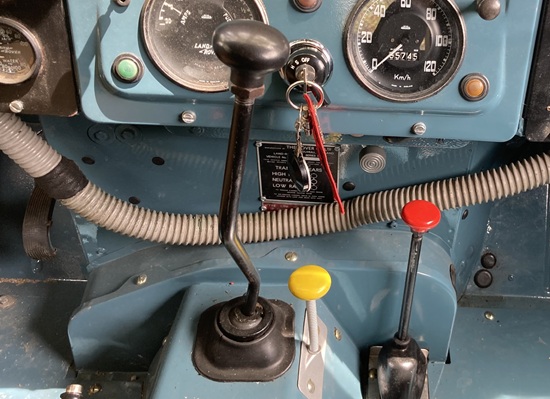
Anyone seating in the spartan cockpit of a Land Rover series immediately notices the multiple levers growing through the floor. You know if a Land Rover is made for you if you get the functioning of the red and yellow levers easily: the logic is odd, but you just have to listen to it to know how it works, without having to understand it: that's the English way. Stop asking why: how is enough !
Lets admit it: the only puzzling thing for most is that
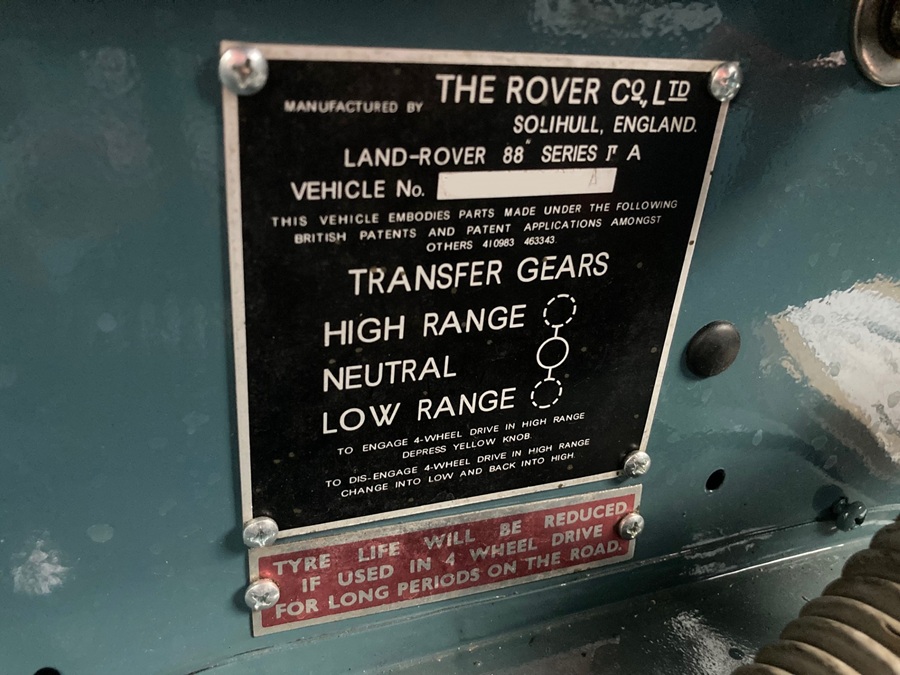
to get out of the 4 wheel drive you MUST proceed first
through the low ratio, even though you don't need it…
.JPEG)
General functionning
Read the way it should be done...
Car in default gear setup (means: high ratio + rear wheel drive only).
TWO things you can do:
-YELLOW KNOB = Engage 4x4 solely: means stay in normal high-ratio, to drive on open roads with 4 wheels engaged;
-RED KNOB = Engage crawling mode: means low-ratio AND 4 wheels drive. You cannot be in low-speed crawling mode without having the 4 wheels driving.
.JPEG)
A word about safety
Safety for the driver and for the car
TO CLUTCH or NOT CLUTCH ?
While engine running: always de-clutch when moving the yellow or red knob.
When engine is off, you can move freely all these levers but they might not be fully engaged next
time you start the car.
WHILE MOVING ?
Now, what about touching these levers while the car is MOVING ? The owner
manual stipulates that you should fully stop
when moving from HIGH to LOW ratio. Otherwise, it is like using the EJECT button of a fighter
jet: be ready for a brutal outcome.
But it is possible to change from LOW to HIGH (to tow an
heavy load until a certain momentum is reached) as long
as you fully de-clutch while moving the red knob lever,
with a quick pause in the middle, and then change the
normal gearbox to 2-3rd gear.
Seems ambitious to move 2 levers without losing too much
speed, but it is written black on white in the
owner's manual that "with practice, it becomes easier"…
So, for one last time, let's have a look at how to
(dis)engage the 4 wheels and the low ratio gearbox using
the yellow and red knobs.
.JPEG)
YELLOW KNOB: Four wheel driving
Meaning at normal speeds
Driving 4WD-engaged on a Series Land Rover is more the exception than the rule. Unlike its modern Defender descendants, who have a permanent 4WD transmission, the older Series are powered through their back axle. It is good to know that a Land Rover can drive almost everywhere using only its rear wheels. But it is a common attitude, in a rush to put all the new levers at play, to switch to 4 wheel drive as soon as the car goes out of the paved roads.
So keep in mind: in a Series Land Rover, drive in "normal" mode until you can't anymore.
When do you need 4 wheels to drive ?
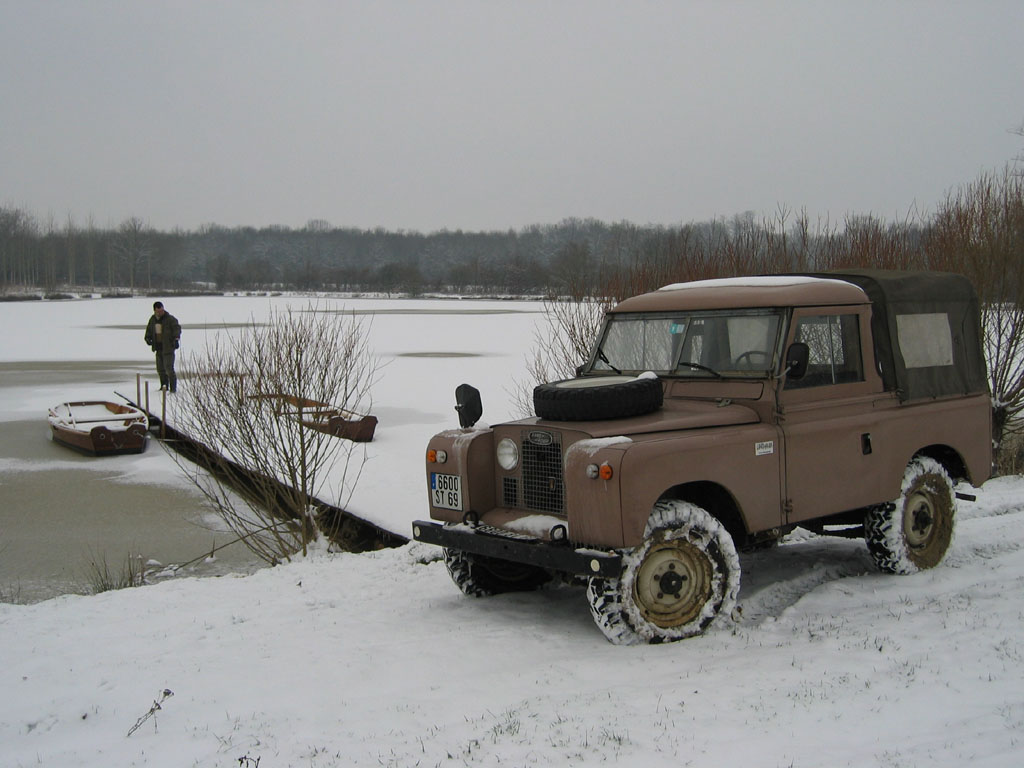
When the power needs to be spread between four wheels, to reduce the risk of slip / spin. Let's say 100% of the engine power is sent to the wheels. With 2 wheel drive, this traction goes 50% to each wheels, which may override the grip available from the ground. With 4 wheels spreading the 100% equally, only 25% of the power will reach the ground at each wheel, therefore giving a chance to each to stay under the maximum ground thrust.
Examples:
-Driving on icy, snowy roads;
-Rear wheels slipping or spinning on a muddy track, sand or wet grass; As the Land Rover is pushed forward by its back transmission axle, it behaves badly in such a condition, like all cars powered through their rear axle. This is a good time to use the YELLOW knob, push it vertically to engage the front axle transmission.
Then, why not stay permanently in high - 4 wheel drive ?
The modern Land Rovers (1985 - 2016) indeed have permanent 4WD but also have a central differential. This key mechanical component provides the necessary flexibility to allow the rear and front axle to spin at different speeds. Without it, the driving at speed becomes dangerous, since the front axle, responsible for turning the front wheels, tends to rip as the transmission spins at an identical speed than the back axle, despite of driving slightly different distance lengths. This leads to dangerous and poor handling.
Another reason, directly related to the above, is the unnecessary wear of the front axle mechanical components, steering UJ and tires.
.JPEG)
RED KNOB: low ratio gearbox
A special transfer gearbox that offers extra gears
When to select low range ?
Examples:
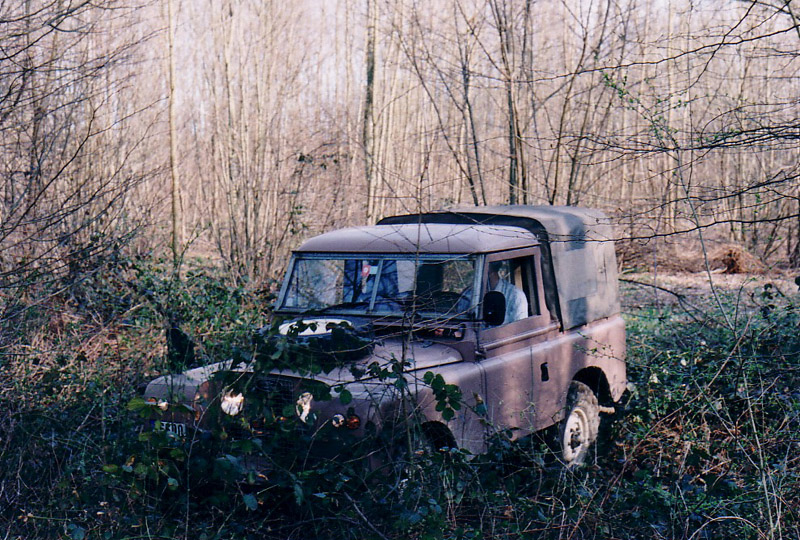
-POWER: towing a car, climbing a steep slope, pulling an heavy load.
-CONTROL: crawling downhill without using brakes, crawling steadily over rocks, without touching the clutch.
FUN FACTS
The 3rd gear in LOW corresponds to the ratio of the 1st HIGH gear. A Series Land Rover cannot engage LOW ratio without 4 wheel drive.
EXECUTION MANUAL
Time to leverage
Default normal is HIGH - 2WD.
Slippery conditions Wanted =HIGH - 4WD: push YELLOW knob.
→back to normal? Wanted = HIGH-2WD: pull RED knob; then push RED knob.
→gets worst: power a/o control needed?
→gets a bit better? Wanted = HIGH - 4WD: not possible, must go first through "normal" HIGH - 2WD.
→back to normal? Wanted = HIGH-2WD: pull RED knob; then push RED knob.
Hopefully, this is clear enough.
And remember: always de-clutch while moving levers...Movement Demonstrations
2WD HIGH to 4WD HIGH
Slippery conditions Wanted =HIGH - 4WD: push YELLOW knob.
2WD HIGH to 4WD LOW
Power a/o control needed Wanted = LOW-4WD: pull RED knob.
4WD HIGH to 4WD LOW
Gets worst: power a/o control needed? Wanted = LOW-4WD: pull RED knob.
4WD HIGH to 2WD HIGH
All clear ! From 4WD HIGH to normal HIGH-2WD: pull RED knob; then push RED knob.