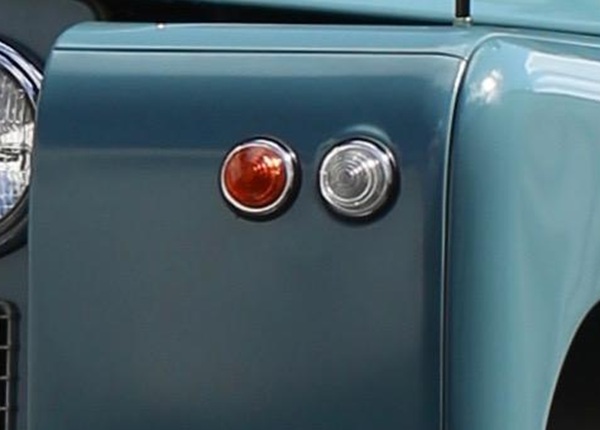
What kind of light lenses for a SIIA Land Rover ?
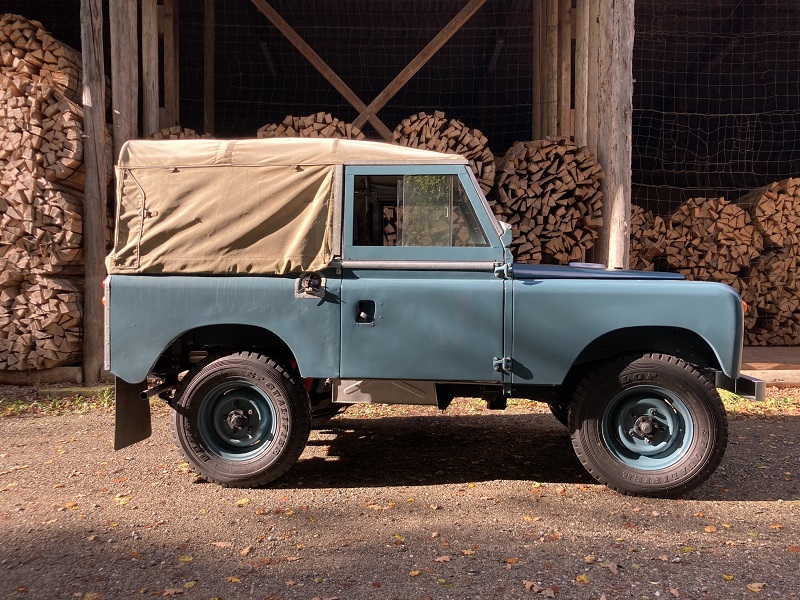
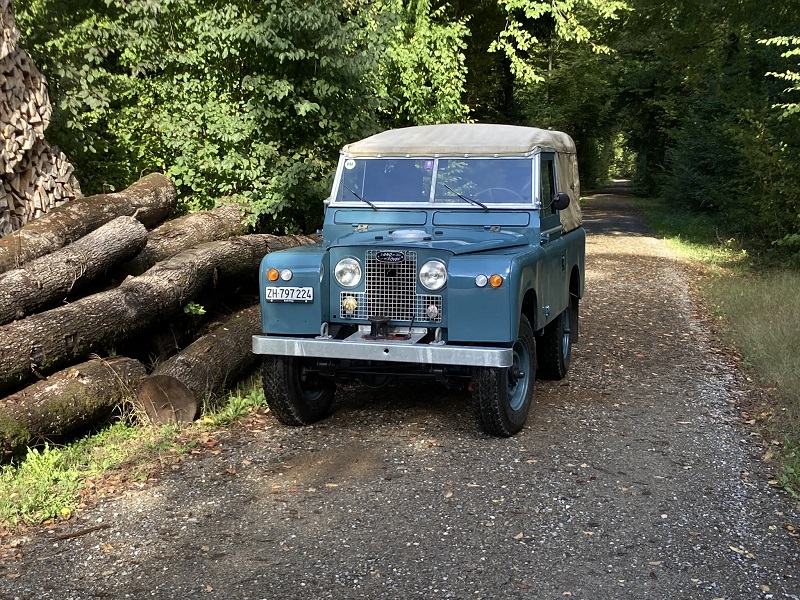
Since purchase in the 90’s, the light lenses on Victoria have been of various plastic replacements, as found on most of the Land Rovers today. On the front end, these lamps comprise two orange turning lights and two clear side lamps. At the back of the car: same turning lights and two red breaking lights. They are cheap and functional. In case of a tree / game / tank encounter, they can be replaced within minutes, secured with just two tiny screws facing forward. Well, until the screws rust, which they do at a quick pace.Yet, they are made of plastic. And as you might have learnt visiting this website, we don’t exactly love plastic in there.
The SIIA was the last Land Rover to carry a very minimal amount of plastic parts, which were massively introduced onto the SIII, launched in 1971. The main drawback of plastic lenses is that, because of UV exposure, their colors fade and the material quickly weakens until it cracks. In addition, the modern LR lenses are (slightly) bigger than the original designs.
So comes the question: is there any “glass” upgrade and if yes, how “genuine” would it be ?
How genuine ?
First, Victoria is anyhow not a 100% original car, far
from that.Second, digging into the reference guide from Land Rover history guru James Taylor “Land Rover Series II and IIA - Specification Guide” only confirmed that the lenses setup in the 60s was quite a mess !
Just out of the 2WW, the car production had to be rationalized, industrial processes followed handcrafting methods, which meant that the few UK-based parts suppliers produced quite a limited amount of parts references, Lucas being one of them (founded in 1875 in Birmingham). But from the 60s, many new automotive suppliers diversified the offer to cope with the tremendous UK car production. As an example: if you own a Series One, you can find precise information of which exact reference of lenses belongs to your car. Starting with the SII models, notably after 1961, the whole British car industry started to use dozen of brands and references of lenses.
So there is no “must have”, and you cannot even be certain which type was factory mounted on a specific car using its VIN or production date. They somehow simply mounted what was available at time of assembly. It seems only that until 1961, mostly glass lenses were mounted to Land Rovers and later a mix of plastic and glass was used, until plastic (sadly) became the only reference made available. Victoria being a 1963 suffix-A Land Rover, she probably was equipped with Lucas or Sparco plastic lenses, but could as well have been one of the last thousands glass lenses equipped car running out of Solihull factory !
Conclusion: glass lenses on Victoria would not be out of place.
What glass lenses exist today ?
Even though most of these options are not fully genuine, we believe that only “rivet counters” will enjoy the following reading.Classic Land Rovers are blessed with numerous parts refabrications. If you can certainly find decent second hand or sky-high-priced NOS offers, there are suppliers faithfully reproducing Lucas designs, going as far as embossing Lucas reference code ! Emberton Imperial, among others internet sellers, offer a choice between two Lucas replicas, both functioning as side indicator, turn signal or stop/tail lamp, with different lens colors (clear, amber, red) upon specific purpose.
The first set is based on the classic Lucas L488 pattern lamp, using a flat design, which was used from the late 1940's onwards and was fitted to many different vehicles, including Lotus and Morgan. This design seems to have been installed on Series One and early SII. It has a 72mm diameter rubber base with 54mm diameter flat glass lens.
The second type is the L594, with its distinctive, beehive-shaped lamp that served as a versatile component for many British classic cars in the 50s and 60s, including MG, Triumph, Austin-Healey, and Morris Minor models. The L594 lamp is sitting on a 72mm diameter rubber base and has a 54mm diameter domed glass lens.
To make things even more confusing, the “flat” side indicator L488 on the front wings was sometimes married to the “domed” L594 amber turning lamp ! Supposedly a transitional setup where the beehive prominent shape made the flashing light more visible from the sides.
After long self-deliberation, it was decided to go for one of the two sets from Emberton Imperial. At a total of 300 CHF (263 GBP incl. shipment and taxes), they don’t come cheap. As a consolation, one can note that the 8 glass lenses sets all include base rings made of stainless steel, for durability. They also include a number plate light made of brass and glass.
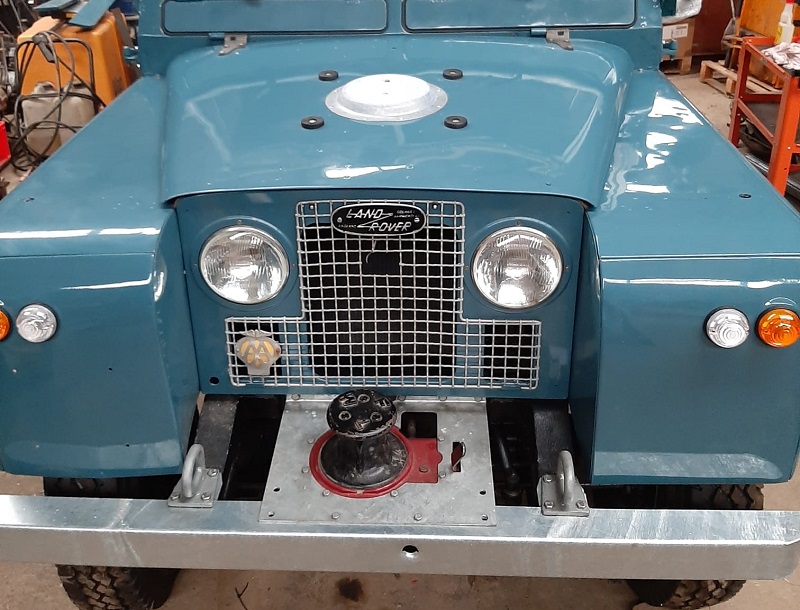
The L594 set was chosen for Victoria. It looks absolutely right on a 1963 SIIA suffix-A, despite the fact that Taylor’s book does not formally mention those in his list of references mounted on SIIA…