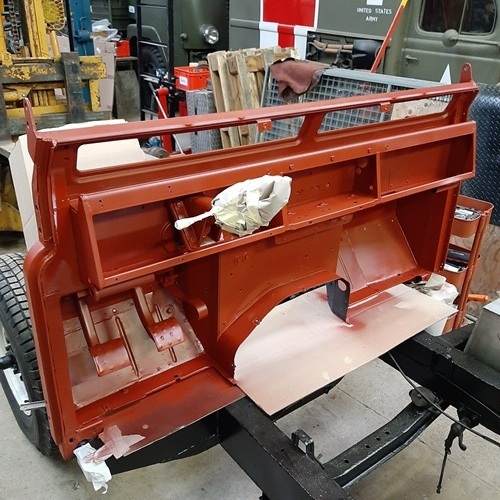
Bulkhead
From the Resto-Mod department
It’s essentially the backbone of the
front bodywork and a critical part of the vehicle’s
structural rigidity.
In Land Rover terminology, the bulkhead refers to the vertical steel panel that separates the engine bay from the cabin. It is the backbone of the bodywork and a critical part of the vehicle’s structural rigidity. It forms the front wall of the passenger compartment and serves as a mounting point for many key components, including:
The pedal assembly (clutch, brake, accelerator)
The steering column
The dashboard and instrument panel
The door hinges
The windscreen frame
Main electrical components and wiring nervous center
While structurally strong, the bulkhead is one of the most rust-prone areas of a Series IIA Land Rover.
Unlike the rest of the body, which is made from aluminum alloy, the bulkhead is made from pressed steel. This choice was necessary for strength and to support load-bearing components, but it also made the bulkhead susceptible to rust, especially in damp climates or where road salt was used.
Restoring a bulkhead often involves cutting out rusted sections and welding in new steel, sandblasting and priming before applying rust-proof coatings.
In Land Rover terminology, the bulkhead refers to the vertical steel panel that separates the engine bay from the cabin. It is the backbone of the bodywork and a critical part of the vehicle’s structural rigidity. It forms the front wall of the passenger compartment and serves as a mounting point for many key components, including:
The pedal assembly (clutch, brake, accelerator)
The steering column
The dashboard and instrument panel
The door hinges
The windscreen frame
Main electrical components and wiring nervous center
While structurally strong, the bulkhead is one of the most rust-prone areas of a Series IIA Land Rover.
Unlike the rest of the body, which is made from aluminum alloy, the bulkhead is made from pressed steel. This choice was necessary for strength and to support load-bearing components, but it also made the bulkhead susceptible to rust, especially in damp climates or where road salt was used.
Restoring a bulkhead often involves cutting out rusted sections and welding in new steel, sandblasting and priming before applying rust-proof coatings.


