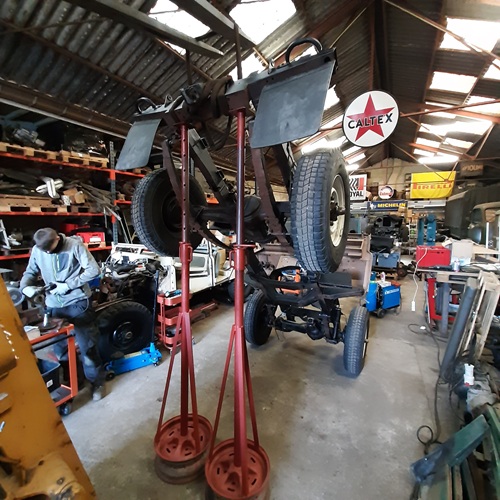
Chassis frame
From the Resto-Mod department
Traditionally, Land
Rovers—especially models like Series, 90-110
Defender and earlier Range Rovers—have used a
ladder-frame chassis, which is essentially a pair of
longitudinal steel beams connected by several
crossmembers. This design provides exceptional
torsional rigidity and strength, making it ideal for
rugged terrain and heavy loads.
One of the key advantages of this type of frame is
its modularity and repairability. If a section of
the chassis becomes corroded or damaged, it can
often be repaired or replaced without needing to
scrap the entire vehicle. This is part of why older
Land Rovers are still so common in remote parts of
the world—they’re built to be fixed in the field.
Ladder-frame vehicles tend to have a higher center
of gravity and less refined suspension setups, which
can result in a rougher ride and less precise
handling.
Sadly, corrosion is a long-term issue. Although the
frames are often treated or galvanized, they are
still vulnerable to rust—especially in older models
or those used in harsh environments. Repairing or
replacing a corroded frame can be expensive and
time-consuming.
Restoring a bulkhead often involves cutting out
rusted sections and welding in new steel,
sandblasting and priming before applying rust-proof
coatings.
Victoria had twice her chassis repaired, but still
runs on an original spec' chassis, which she can be
proud of !


